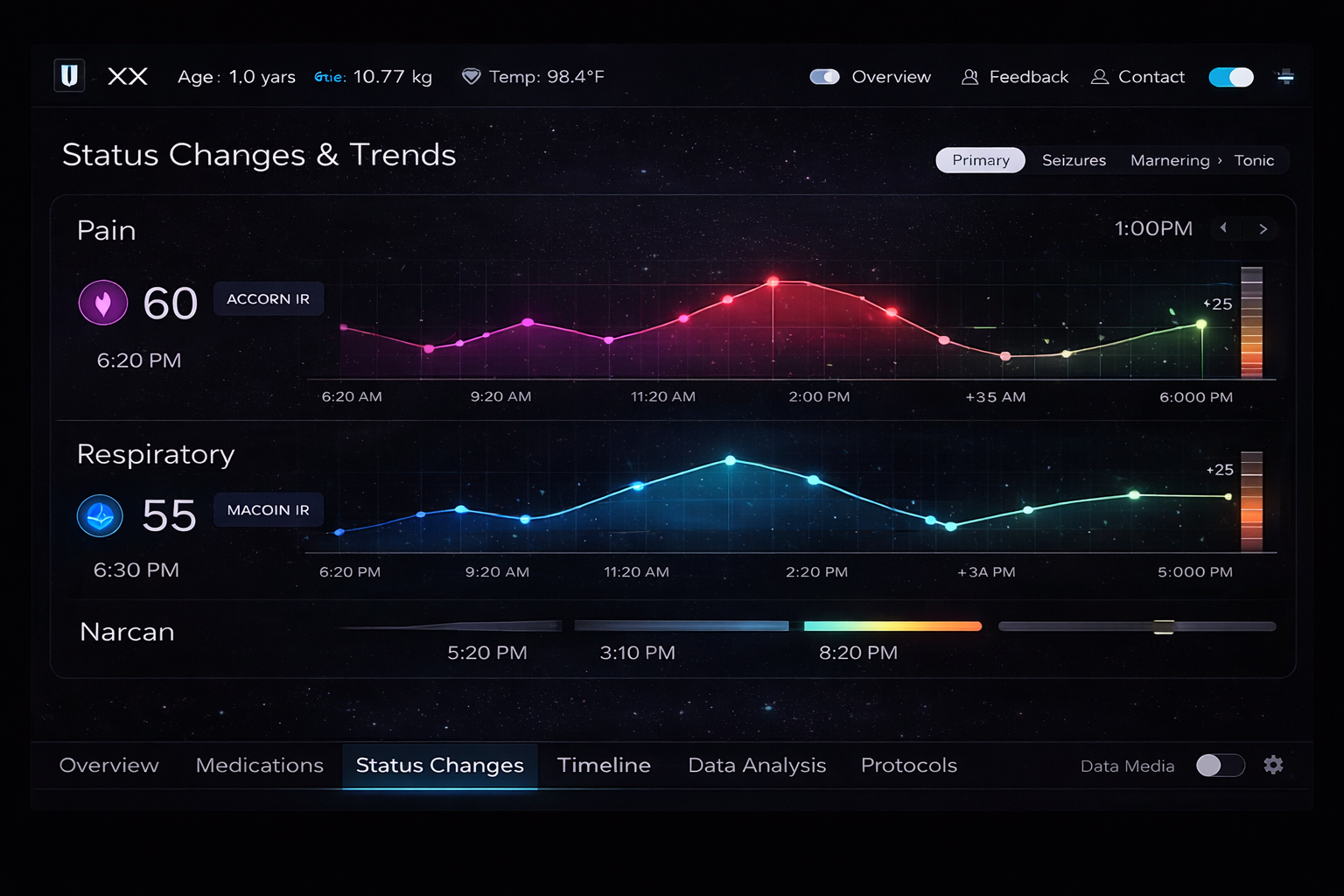
Understanding the Status Changes & Trends module
This module logs and visualizes changes in patient status across multiple systems over time. It tracks percentage-based severity indicators for respiratory, pain, skin, infection, and other systems with precise timestamps. The trend data shows not just the current state, but the trajectory — whether a system is improving, stable, or deteriorating. Color-coded severity levels provide immediate visual cues about the direction and magnitude of changes.
Why it matters clinically
Understanding how a patient is trending is often more clinically valuable than knowing their current state alone. A patient whose respiratory status has declined from 20% to 90% severity over several hours tells a very different story than one who has been stable at 50%. This temporal context is critical for anticipating deterioration, evaluating treatment effectiveness, and making proactive rather than reactive clinical decisions.
How AI could assist
The AI advisor in this module focuses on identifying meaningful trends, highlighting significant deviations from baseline, and explaining what changes may indicate in general clinical terms. It supports time-based reasoning, comparison to previous states, and recognition of emerging patterns — while avoiding overinterpretation of small fluctuations.
Important: This system supports clinical decision-making and does not replace physician judgment. All AI-generated insights should be validated by qualified medical professionals.
Example Clinician Questions
Value when connected to EMR and real-time data
When connected to continuous monitoring feeds, laboratory results, and nursing documentation, this module can provide automated trend detection with clinically meaningful thresholds. Integration with predictive analytics could enable early warning scores that alert teams to deterioration before it becomes critical, fundamentally shifting care from reactive to proactive.
Help us improve this module
We are actively seeking feedback from clinical practitioners to shape the future of this platform.